

Warmer temperatures mean days on the water, backyard barbecues and plenty of time soaking up the sun. Melissa Williams, MD, PPG – Dermatology, offers these fast facts and smart tips for protecting yourself from the harmful effects of those risky rays.
Sun facts
- Remember that ultraviolet A rays from the sun come through window glass. Therefore, even when driving in your car or sitting next to a window inside, you are getting sun.
- Cloudy days do not protect you from getting a sunburn. Even on a cloudy day, you must practice good sun protection.
- Ultraviolet radiation from the sun increases your risk of all types of skin cancer (basal cell carcinoma, squamous cell carcinoma and melanoma).
- Tanning beds are 13.2 times more effective at delivering radiation to your skin, which dramatically increases your skin cancer risk.
Ways to protect your skin
- Seek shade when possible.
- Avoid prolonged sun exposure during the peak sun hours when the sun is strongest (typically between 10 a.m. and 2 p.m.).
- Cover your skin with long sleeves or broad-brimmed hats. If you’re wearing a baseball hat, apply sunscreen to your ears. Skin cancer can and commonly does occur on this part of the body.
- Wear sun-protective clothing. It will say UPF on the tag, instead of SPF. These are available at most outdoor stores or online. Coolibar and Solumbra are two popular brands.
- Protect your eyes from the sun with polarized sunglasses or lenses. Melanoma can occur in the eye as well.
- Wear sunscreen. Use at least SPF 30 broad-spectrum sunscreen. You can use a cream, lotion, spray, or sticks, whichever is most convenient for you. The stick is popular because it doesn’t get on your hands, so it’s less messy.
- For infants under 6 months, sunscreen is not recommended. Cover them with sun protective clothing, broad-brimmed hats, and seek shade.
- For children 6 months to 18 months, I recommend using sunscreens with physical blockers only. Look at the label for titanium dioxide or zinc oxide.
- Re-apply sunscreen every 90 minutes, since sunscreen becomes deactivated with time in the sun and sweating/water.
- If you will be in the water, make sure to reapply sunscreen every 40-80 minutes, even if it says it’s water-resistant.
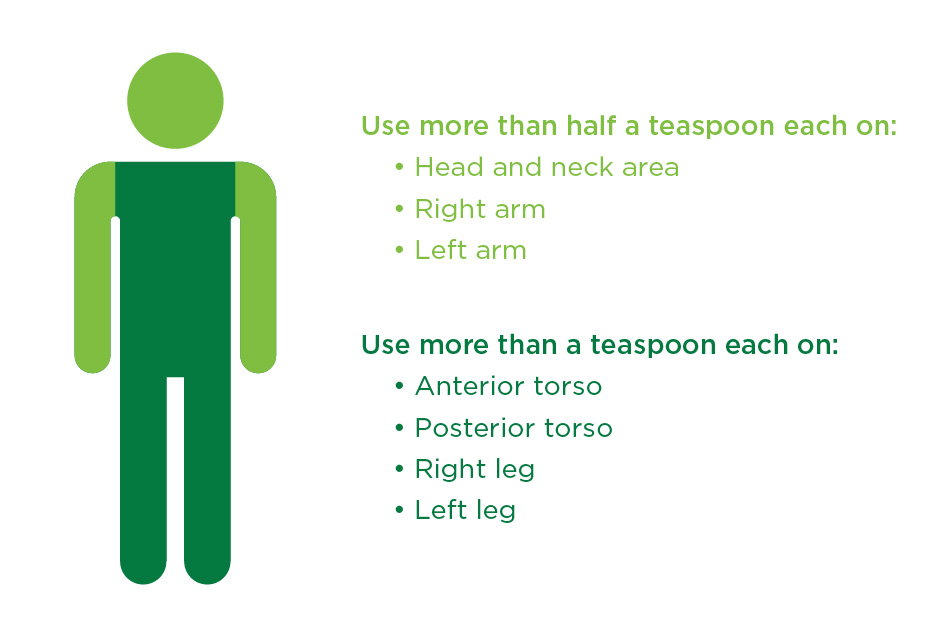
- Make sure to apply enough sunscreen. When sunscreens are tested to determine their SPF, they are applied at 2mg/cm2. However, studies show that most people only apply them at 1mg/cm2, therefore you are not getting the full protection of your sunscreen. Please see the helpful guide below, on how much sunscreen to use in each body location:
Sources
Schneider J. The Teaspoon Rule of Applying Sunscreen. Arch Dermatol. 2002;138(6):838–839. doi:10.1001/archderm.138.6.838